
Charge-carrier photogeneration in single-component organic carbazole-based semiconductors via low excitation power triplet-triplet annihilation
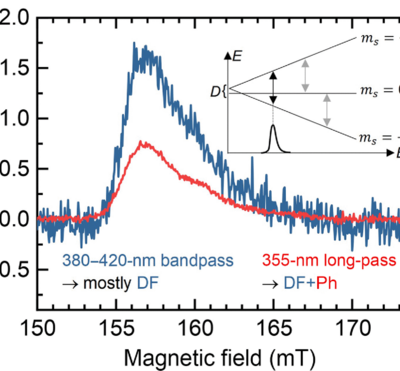
It is generally believed that intrinsic charge generation via an autoionization mechanism in pristine single-component organic semiconductors is impossible upon photoexcitation within the lowest excited singlet state due to the large exciton binding energy. However, we present measurements of thermally stimulated luminescence, light-induced ESR, and photocurrent in the carbazole-based molecule 3′,5-di(9H-carbazol-9-yl)-[1,1′-biphenyl]-3-carbonitrile (mCBP-CN) films, revealing that charge-carrier pairs are efficiently produced upon excitation near their absorption edges. The photocurrent measurements show a superlinear dependence on the cw-photoexcitation intensity even at very low excitation power (below 1mW/cm2), suggesting a bimolecular nature of the charge photogeneration process. The photocurrent measured over a broad temperature range of 5–300 K exhibits a prominent maximum at moderately low temperature around 170 K and rolls off significantly at higher temperatures. This correlates remarkably with the maximum of delayed fluorescence induced by bimolecular triplet-triplet annihilation (TTA), i.e., triplet fusion, in this material. This behavior implies that the photocurrent is governed mainly by the TTA-induced production of geminate pairs and only a little by their subsequent dissociation. Moreover, we find that the field-assisted dissociation probability of photogenerated charge pairs becomes almost temperature-independent at temperatures below 100 K. This can be quantitatively described using a charge dissociation model accounting for the energy disorder and the distribution of geminate-pair radii. The key conclusion of this study is that triplet fusion can promote the energy up-conversion (to 5.42 eV), thereby enabling the autoionization of a high-energy neutral excited state. This serves as the predominant mechanism of intrinsic photogeneration in this single-component heavy-atom-free system. We attribute the effect to efficient intersystem crossing in mCBP-CN, a high triplet energy level (2.71 eV), and very long-lived triplet excitations. A broader implication of this finding is that the so far neglected mechanism of TTA-facilitated charge-carrier generation might be relevant for organic long-persistent luminescence materials, and even for organic photovoltaics and potentially for photocatalytic water splitting processes.It is generally believed that intrinsic charge generation via an autoionization mechanism in pristine single-component organic semiconductors is impossible upon photoexcitation within the lowest excited singlet state due to the large exciton binding energy. However, we present measurements of thermally stimulated luminescence, light-induced ESR, and photocurrent in the carbazole-based molecule 3′,5-di(9H-carbazol-9-yl)-[1,1′-biphenyl]-3-carbonitrile (mCBP-CN) films, revealing that charge-carrier pairs are efficiently produced upon excitation near their absorption edges. The photocurrent measurements show a superlinear dependence on the cw-photoexcitation intensity even at very low excitation power (below 1mW/cm2), suggesting a bimolecular nature of the charge photogeneration process. The photocurrent measured over a broad temperature range of 5–300 K exhibits a prominent maximum at moderately low temperature around 170 K and rolls off significantly at higher temperatures. This correlates remarkably with the maximum of delayed fluorescence induced by bimolecular triplet-triplet annihilation (TTA), i.e., triplet fusion, in this material. This behavior implies that the photocurrent is governed mainly by the TTA-induced production of geminate pairs and only a little by their subsequent dissociation. Moreover, we find that the field-assisted dissociation probability of photogenerated charge pairs becomes almost temperature-independent at temperatures below 100 K. This can be quantitatively described using a charge dissociation model accounting for the energy disorder and the distribution of geminate-pair radii. The key conclusion of this study is that triplet fusion can promote the energy up-conversion (to 5.42 eV), thereby enabling the autoionization of a high-energy neutral excited state. This serves as the predominant mechanism of intrinsic photogeneration in this single-component heavy-atom-free system. We attribute the effect to efficient intersystem crossing in mCBP-CN, a high triplet energy level (2.71 eV), and very long-lived triplet excitations. A broader implication of this finding is that the so far neglected mechanism of TTA-facilitated charge-carrier generation might be relevant for organic long-persistent luminescence materials, and even for organic photovoltaics and potentially for photocatalytic water splitting processes.